Inspiration
A photograph that caught my eye this morning on Google+ was a picture by . My initial reaction was "Whoa, that's amazing!" It's a lovely image in soft pastels of something I've never seen before. Fortunately Mr Sojka gives some background to his shots and explains that this is a broken Moeraki boulder on the Otago coast of New Zealand. I don't know the scale of the boulder from the shot, but it looks quite large to me. Quite how such large boulders could be just sitting there on the beach puzzled me so to google I went.Description
The picture below shows unbroken boulders. Moeraki boulders are roughly spherical and up to 3m in diameter. They are covered in cracks called septaria.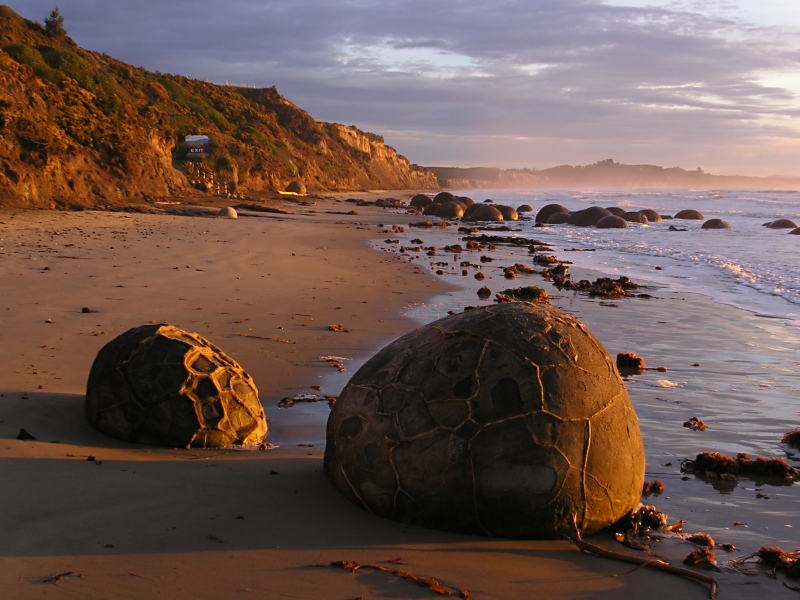 |
| Moeraki Boulders at Sunrise by Karsten Sperling via Wikipedia Commons |
Formation
 |
| Not to scale! |
The cracks which taper off from the centre to the outer layer are taken as evidence that the surface was more rigid than the softer inside and so could not shrink as much. This is attributed to the differing amounts of calcite in the different layers.
There are several suggestions as to why the cracks formed:
- dehydration of clay rich, gel rich or organic rich cores,
- shrinkage of the boulder's cenre,
- expansion of gases produced by decaying organic matter,
- brittle fracturing or shrinkage of the interior by earthquake or compaction.
They are exposed when the softer surrounding mudstone is eroded by the elements.

