Showing posts with label planets. Show all posts

Monday, 11 April 2011

10th April 2011 Uranus

Uranus appears as a blue green planet. This is because the methane in its atmosphere absorbs all red light.
It has 27 moons, all small, which are named after characters in Shakespeare.

Most planets are spinning like a top in their orbit. For instance, the earth's axis is 23.5 degree from vertical. However, Uranus is on its side.  Its axis points to the sun. Its north pole gets 42 years of light followed by 42 years of dark.

Why would Uranus orbit on its side?

It was thought that something very big hit it, but its moons are in same plane so that doesn't make sense.
A new suggestion, from many computer simulations is as follows. When the giant planets Saturn, Jupiter, Uranus and Neptune were formed, they were close together. The then interacted and migrated. In one set of contrived circumstances, it is thought that Uranus got knocked slightly out of its orbiting plane. This along with a big moon (1% of planet mass) would be enough to knock it on its side. Then somehow the big moon disappeared. It could have been snatched away because Uranus was close to another planet perhaps.

Discovery

Sir William Herschel discovered it in 1781. He wanted to name it Georgium Sidus after King George III but Europe didn't like it. Eventually they decided on Uranus since Uranus is the father of Saturn, and Saturn the father of Jupiter (Greek mythology). It was not until 1850 that it was universally accepted.

Uranium, discovered about 8 or 9 years after Uranus, was named after the planet. This helped the name stick.

References

http://en.wikipedia.org/wiki/Uranus
http://www.sixtysymbols.com/videos/uranus.htm

Sunday, 10 April 2011

10th April 2011 Plantery Systems

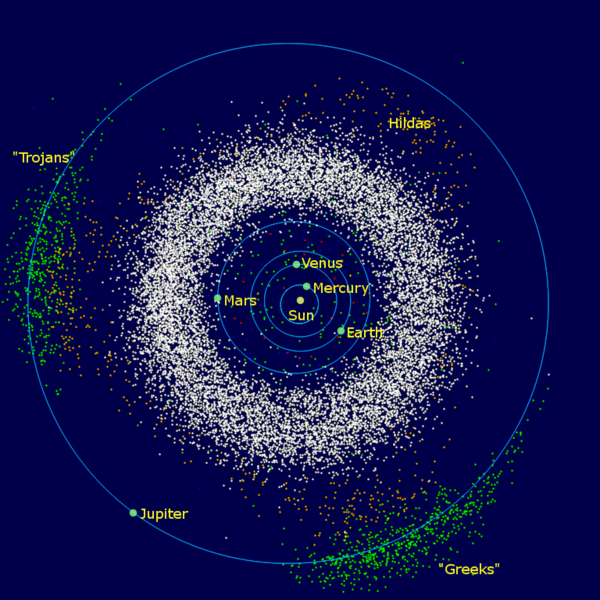
In the middle of the asteroid belt, which is the white dotted region in the image below, is the frost line (aka snow line or ice line).   It's about 2.7 AU (astronomical units) from the sun. 2.7 AU is approximately 4 x 10⁸. An astronomical unit is approximately the mean distance from Earth to the Sun.

The frost line is the distance at which hydrogen compounds such as water, methane and ammonia exist as ice. This temperature at which this occurs is estimated to be below about 150 K.

from Wikipaedia
This line separates the Jovian planets, Jupiter, Saturn, Uranus and Neptune from the terrestrial planets.  Jovian planets are not primarily composed of solid matter such as rock, but of gases.  The are also called gas giants.

Planet Types

By Size

Size MinSize MaxName
>1 Earth Mass<10 Earth MassesSuper earth or gas dwarf
>10 Earth Masses<13 Jupiter MassesGas giant
>13 Jupiter Masses< Mass of small starBrown dwarf (Note: able to start deuterium fusion)

By Composition

NameDescriptionExample
Silicate planet A planet made mostly of silicon based rocky mantle with an iron core.Earth
Iron planetA theoretical type of planet consisting of almost only iron which thus has higher density and a smaller radius than other terrestrial planets of comparable mass. They are believed to form in the high density region close to a star if the protoplanetary disk is rich in iron.Nearest to this is Mercury whose metallic core is about 60-70% of its mass.
Coreless planetA theoretical type of terrestrial planet that consists of silicate rock but has no metallic core. Coreless planets are believed to form farther from the star where volatile oxidizing material is more common.Chondrite asteroids and meteorites
Carbon planet or diamond planetA theoretical type of terrestrial planet, composed primarily of carbon-based minerals.Carbonaceous asteroids

Astronomy Without A Telescope – Our Unlikely Solar System

Sunday, 3 April 2011

3rd April 2011 Interview with Neil deGrasse Tyson

70% of Mercury is iron, and it has a strong magnetic field.
Venus has a runaway greenhouse effect.
There are dried river beds, and flood plains on Mars but no evidence of water there now. Recent evidence has suggested that the water went below the surface.  On Earth, every place with liquid water has life so following the water on Mars makes sense.  Maybe there will be DNA found, and if so will it be an independent source or linked to DNA on earth?

Interview with Neil deGrasse Tyson