Showing posts with label astronomy. Show all posts

Monday, 18 April 2011

16-18th April 2011 The Sun

Comparison of the Sun and Earth

The Sun has a radius of a little under 700 thousand km which is a bit over 100 times Earth's. Its mass is about 2 x 1030, around 300 thousand times heavier than Earth. This means that it is rather less dense than the Earth, with a density which is only a quarter of Earth's.

How old is the Sun?

The Sun was formed about 4.57 billion years ago when a cloud of  hydrogen molecular gas collapsed.

How far away is the Sun from Earth?

The distance from the Sun to the Earth varies slightly, but is around 1 AU (astronomical unit) which is about 150 million km.

What elements are present in the Sun?

The Sun comprises of mostly hydrogen (90.965%) and helium (8.889%) with small amounts of oxygen (774 ppm), carbon (330 ppm), neon (112 ppm), nitrogen (102 ppm), iron (43 ppm), magnesium (35 ppm), silicon (32 ppm) and sulphur (15 ppm).  [NASA: Sun Fact Sheet ] These are all products of stellar nucleosynthesis, which is the process by which hydrogen fuses together to form the other elements.

When the hydrogen runs out, the Sun will explode and ultimately die. There is enough hydrogen for another 5-7 billion years. [Universe Today: When will the Sun die?]

How long does it take sunlight to reach Earth?

From the surface of the sun, the light takes 8 minutes, but that's only the end of the story. What we see as light starts deep within the Sun, in its core.  When fusion occurs, it not only produces the elements mentioned above, but it also produces photons and neutrinos. The neutrinos pass through pretty much anything, so they disperse immediately. The photons, on the other hand, are absorbed by the first few millimetres of plasma. They are then re-emitted, with slightly less energy, in a random direction. This means that they take a random walk in order to reach the surface of the Sun. Old textbooks estimated it to take 17 thousand to 50 million years but using a more accurate mathematical model gives a estimate of 10-170 thousand years. So what we see as sunlight actually took at least 10 thousand years to get here! [NASA: Ancient Sunlight]

What is the structure of the Sun?

The sun consists of various layers at different temperatures.


LayerTemperature
in Kelvin
Location
Core15 millionFrom the centre to
20-25% of radius
Radiative zone5-10 millionFrom 20-25% up to
70% of radius
Convective zone2 million200 000 km to
 the surface
Photosphere6600-4400The surface
(10-400 km thick)
Temperature minimum4100About 500 km
above the surface
Chromosphere 4300-30000
Up to 10000 km
above the surface 
Transition
region
0.02-1 millionAbout 200 km
thickness above
the chromosphere
Corona0.5-2 or 3 millionFrom 2500 km and
upwards
Heliosphere
Out to past Pluto!
  • Core
Fusion burns hydrogen to produce various elements and release neutrinos and photons.
  •  Radiative Zone  
This layer is sufficiently dense for heat to travel by thermal radiation. No thermal convection occurs here. Instead, the photons are absorbed and emitted by hydrogen and helium ions as they travel through the layer.
  • Convective Zone
Plasma is heated by the radiative layer. This plasma rises, taking heat with it. When it cools, the plasma sinks back down to again be heated.
  • Photosphere
This is the visible surface of the Sun. It's a relatively thin layer. We can not see further into the Sun than this level as deeper down is opaque due to a higher density of H- ions, called hydrogen anions, in lower levels.

The plasma from the convective layer breaks through to the surface here, allowing light to escape

In 1868, Norman Lockyer hypothesised that absorption lines detected in the photosphere were a new element, unknown on Earth at the time. He called this hypothetical element helium after the sun god Helios. It was 25 more years before helium was isolated on Earth.

  • Temperature minimum
As the name suggests, the temperature minimum is the coolest part of the Sun.  It is sufficient cool that the spectra of simple molecules such as carbon monoxide and water can be detected.
  • Chromosphere
The chromosphere can only be detected using narrow-band filters. During a total eclipse it can be seen as a thin band of colour around the sun.
  • Transition region
Below this layer, gravity is the dominant force. Helium is totally ionised in the transition region. Ionised helium slows radiative cooling of the plasma. This allows the rapid rise in temperature in this region.
  • Corona
The fourth layer of the Sun's atmosphere. It is visible in a total eclipse. It consists of very low density plasma. It is continually expanding into space to form the solar winds.

  • Heliosphere
The fifth and final layer of the Sun's atmosphere stretches out to the edges of the Solar System, providing a protective bubble of solar gas which moves with the Sun. This gas is continually emitted from the Sun as solar winds.  It protects the Solar System from ionised galactic gas and from most of the cosmic energetic particles.

What causes weather on the Sun?

Because the Sun is made of gas, it doesn't rotate in the same way as the Earth, a more solid structure.
The inside of the Sun rotates more quickly than the outside. The centre is being twisted much more quickly than the  top and bottom. This twists all the magnetic lines to such an extend that they cause tension and disruptions on the surface of the Sun, which gives rise to the Sun's weather.

Eventually these lines become so tangled that adjacent areas have opposite magnetic fields. This is instable so some areas have to change their field to match their neighbour's. Overall, this causes a reversal of the magnetic poles. This pole reversal occurs about every 11 years.

Summary of Sources

1 .365 Days of Astronomy: 15th April 2011 Our Sun
2. Wikipedia: Sun
3 .NASA: Sun Fact Sheet
4. Wikipaedia: Stellar nucleosynthesis
5. Universe Today: When will the Sun die?
6. NASA: Ancient Sunlight
7. Wikipaedia: Hydrogen anions
8. Universe Today: Sun's Atmosphere
9. Solanki, S.K.; , W. and Ayres, T. (1994). "New Light on the Heart of Darkness of the Solar Chromosphere". Science 263 (5143): 64–66.
10. Space Ref: The Distortion of the Heliosphere: our Interstellar Magnetic Compass

Saturday, 16 April 2011

16th April 2011 Nibiru and 2012

I decided to look into the calculations I found on the mysterious imaginary planet of Nibiru which is supposed to crash into Earth on 21st December 2012, ending the world as we know it.

How big would Nibiru's orbit be?

Its orbit takes 3600 years and is an ellipse with the sun as one of its two foci. [Kepler's First Law: "The orbit of every planet is an ellipse with the Sun at one of the two foci."]

Kepler's third law states that
"The square of the orbital period of a planet is directly proportional to the cube of the semi-major axis of its orbit."  
The semi-major axis is the maximum distance of the orbit from its centre.

Let P be the orbital period of Nibiru (in sidereal years) and a be the semi-major axis of its orbit (in AU). Then
P 2 α  a3
Since the constant is 1 for the units given, that is,  (sidereal year)2(AU)−3,
P 2 = a3
and thus
a is the cube root of 3600  2
Since Niribu is supposed to come close to Earth or even hit it, we assume that this is the closest Nibiru gets to the sun, one of its foci. This closest point is called the perihelion. So if 1 AU is the perihelion, what is the distance to the aphelion, the furthest point from the sun?

From the diagram, we see that it is simply twice the semi-major axis minus 1 AU. That is, the cube root of 36002 minus 1 which is 469 AU to the nearest AU.  The diagram below shows the comparative maximum distances in AU from the sun


Max distance from the sun in AU

and the table gives the figure for each of the planets.


PlanetOrbital
Period
years 
Max
Distance
from Sun
AU 
Min
Distance
from Sun
AU 
Average
Orbital
Speed
km/s 
Mercury0.240.470.3147.87
Venus0.620.730.7235.02
Earth11.020.9829.78
Mars1.881.671.3824.08
Jupiter11.865.494.9513.07
Saturn29.4610.129.059.69
Uranus84.3220.0818.386.81
Neptune
163.7930.4429.775.43
Pluto248.0949.3129.664.67
Nibiru36004691???

What would its orbit look like?

Using Dr. Douglas P. Hamilton's Orbital Calculator, the values semimajor axis 235 AU, eccentricity 0.995744 and eccentric anomaly 1.418 give the min and max values described above. [Source]  This gives a semiminor axis of about 20 AU.  Eccentricity is a measure of how far from a circle an ellipse is and ranges from 0 (for a circle) to 1.  The orbit is cigar shaped.

How fast is it going?

Nibiru's orbit sends it 469 AU from the Sun.  The gravity from the Sun on Nibiru at such a distance, if it has about the same mass as the Earth, would be around 1/4 millionth that of the Sun on the Earth. Since the gravity is so little, Nibiru will have almost escaped from the Sun's gravity. In order to do this, when it is close in to the Sun, it must almost reach the Sun's escape velocity.  The Sun's escape velocity at Earth's orbit is about 42 km/s.  That means Nibiru would be travelling at somewhere between the speed of Mercury and Venus.  If my calculations are anything like correct, it would seem to only be going at about 0.09 km/s when it's at its aphelion. [Using Kepler's Second Law:"A line joining a planet and the Sun sweeps out equal areas during equal intervals of time."]
It seems I'm doing something wrong since apparently, Nibiru's orbital velocity is
3.8 x 10⁸ Kilometres per year (or roughly 2.5 AU a year). [Source]
So, for Nibiru to be here on 21st December 2012, it would have to be around 4.2 AU from Earth now. That is around Jupiter's orbit. Surely it would be visible either through infrared or visible light or by gravitational effects?

From this source, Nibiru would be around 7.2 AU from the Sun now, and of magnitude 4.8, if it were the size of Earth.

How will other planets and objects affect its orbit?

Such an elongated orbit is highly unstable (why? I don't know) and so any interaction with a planet or anything else could easily knock it off its orbit.


http://www.2012hoax.org/nibiru
http://www.sjsu.edu/faculty/watkins/orbital.htm
http://astroblogger.blogspot.com/2011/04/looking-for-nibiru.html
http://www.astrosociety.org/2012/ab2009-32.pdf
circumference of an ellipse calculator 

Wednesday, 13 April 2011

13th April 2011 Asteroid Belt

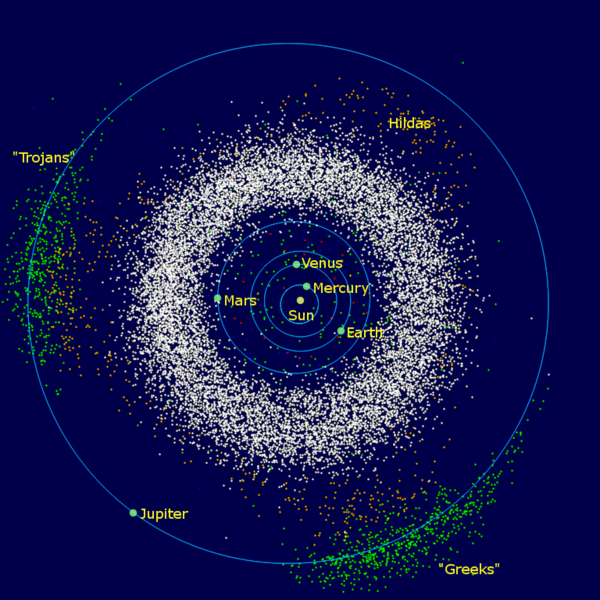
The Main Asteroid Belt shown in White

The main asteroid belt lies between Mars and Jupiter. It consists of asteroids from a few centimetres in diameter to the size of a dwarf planet.

Due to strong gravitational forces, it is impossible for a planet or large protoplanet to survive between Mars and Jupiter without being ripped apart. So the asteroid belt might be the remains of a planet which has been ripped apart.

Discovery of the First Asteroid

Many calculations were done in the early 18th century to calculate the number of asteroids and accurate answers were found. However, actually seeing the asteroids was a more difficult problem, and it took until 1st January, 1801 for Guiseppe Piazzi to find the first one. He wrote in his diary
"The light was a little faint, and of the colour of Jupiter, but similar to many others which generally are reckoned of the eighth magnitude. Therefore I had no doubt of its being any other than a fixed star. In the evening of the second I repeated my observations, and having found that it did not correspond either in time or in distance from the zenith with the former observation, I began to entertain some doubts of its accuracy. I conceived afterwards a great suspicion that it might be a new star. The evening of the third, my suspicion was converted into certainty, being assured it was not a fixed star. Nevertheless before I made it known, I waited till the evening of the fourth, when I had the satisfaction to see it had moved at the same rate as on the preceding days."
and in a letter to astronomer Barnaba Oriani of Milan he made his suspicions known in writing:
"I have announced this star as a comet, but since it is not accompanied by any nebulosity and, further, since its movement is so slow and rather uniform, it has occurred to me several times that it might be something better than a comet. But I have been careful not to advance this supposition to the public."
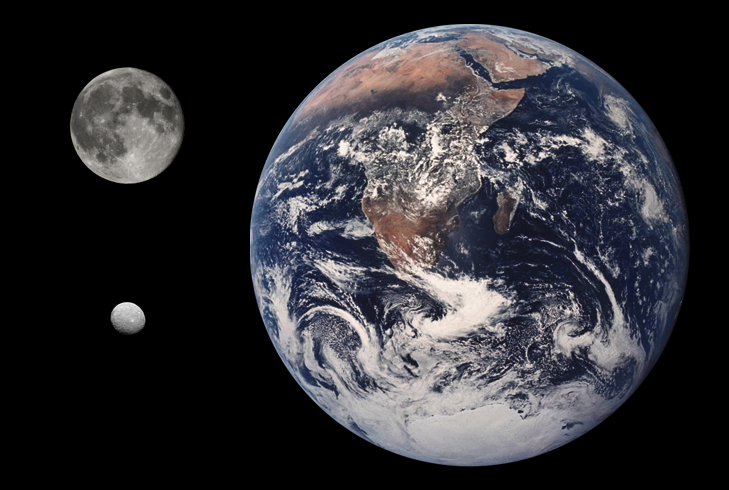
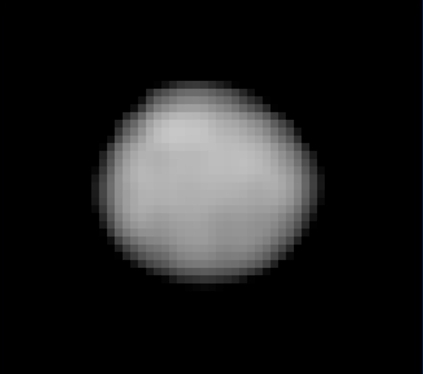
Piazzi called his discovery Ceres, and for 50 years it was known as the 8th planet in the Solar System.  It is the largest of the asteroids and is now classified as a dwarf planet. It is the only dwarf planet in the asteroid belt. Its diameter is about 950 km and contains 32% of the belt's total mass.
Ceres - taken by Hubble
The following image from NASA shows the comparison of sizes between Earth, the moon and Ceres.
From Wikimedia Commons

First Ten Asteroids Discovered

Sizes of the first ten Asteroids to be discovered compared to the Earth's Moon, all to scale. 
NameSizeMass
% of belt mass
  (x 1020  kg)  
Discovery
date
Discoverer
1 Ceres  950 km diameter      32%
9.43 ± 0.07
1st January, 1801  Guiseppe Piazzi
2 Pallas530-565km diameter      7%
2.11 ± 0.26
28th March, 1802 Heinrich Olbers
3 Juno320×267×200 km     1%
0.267 
1st September, 1804Karl Ludwig Harding
4 Vesta578×560×458 km     9%
2.67 ± 0.02
29th March, 1807Heinrich Olbers
5 Astraea167×123×82 km     0.1%
0.029
8th December, 1845Karl Ludwig Hencke
6 Hebe 205×185×170 km     0.4%
0.128
1st July, 1847Karl Ludwig Hencke
7 Iris
225×190×190 km
      0.4%
0.136
13th August, 1847John Russell Hind
8 Flora136×136×113 km      0.1%
0.043
18th October, 1847John Russell Hind
9 Metis
235×195×140 km
       0.5%
0.147 ± 0.020
25th April, 1848Andrew Graham
10 Hygiea500×385×350 km      3%
0.885
12th April, 1849
Annibale de Gasparis
365 Days of Astronomy

Tuesday, 12 April 2011

12th April 2011 Moon

Unlike the Earth the Moon's axis is only at 1.5 degrees to the Sun. This means that it has no seasons, and that each place receives the same amount and type of sun all year long. This means that some places, namely craters at the poles, are permanently in shadow. If anything lands in those craters, it will never see the sun again, and never receive any heat. What does this mean? If ice lands in a crater at the poles, then it will stay there. So what is in those craters? Maybe one day we will find out. Starts with a Bang

Monday, 11 April 2011

11th April 2011 Asteroid - Kleopatra

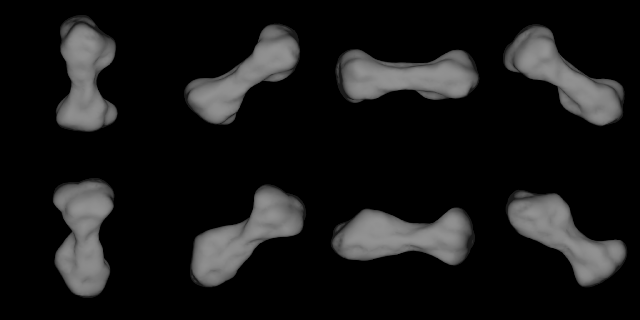
Kleopatra is a 217 km long  and 58 km wide asteroid which was discovered on April 10, 1880 by Johann Palisa.. In 2000, it was found to be shaped like a bone. It orbits the sun in an orbit outside Mars.  It rotates by tumbling end over end.
NASA
A recent study determined that  Kleopatra is 30-50% empty space.

It also has two moons, Cleoselene (inner) and Alexhelios (outer), which were discovered in 2008. They are between 5 and 10 km in diameter and orbit at 454 and 678 kilometers around Kleopatra.

Sources

Bad Astronomy
The Planetary Society
Astroblogger
Wikipedia
NASA

11th April 2011 Comet Elenin

A while ago, someone posted a link to a video of a woman predicting an earthquake when the Japanese quake occurred. She said that it was because comet Elenin, the earth and the sun were in a straight line.

Here are some facts about Elenin.
  •  The closest Elenin will come to us is 0.24 AU - that is slightly closer than the closest Venus gets to us and (100 x distance to moon).
  •  Elenin passed its closest on 2nd April 2011, and its orbit remains unchanged.
  • It's tidal force is 1/billion times that of the moon so it wont cause Earthquakes - not even the moon does that!
  • We may pass through its tail, but that is smaller than Halley's tail. 
  • It's around 3-4 km in diameter.
  • It may evaporate (thought to be 50% chance) when it gets nearer to the sun as it's either a dirty snowball or icy dirtball, possibly barely holding together.

10th April 2011 Uranus

Uranus appears as a blue green planet. This is because the methane in its atmosphere absorbs all red light.
It has 27 moons, all small, which are named after characters in Shakespeare.

Most planets are spinning like a top in their orbit. For instance, the earth's axis is 23.5 degree from vertical. However, Uranus is on its side.  Its axis points to the sun. Its north pole gets 42 years of light followed by 42 years of dark.

Why would Uranus orbit on its side?

It was thought that something very big hit it, but its moons are in same plane so that doesn't make sense.
A new suggestion, from many computer simulations is as follows. When the giant planets Saturn, Jupiter, Uranus and Neptune were formed, they were close together. The then interacted and migrated. In one set of contrived circumstances, it is thought that Uranus got knocked slightly out of its orbiting plane. This along with a big moon (1% of planet mass) would be enough to knock it on its side. Then somehow the big moon disappeared. It could have been snatched away because Uranus was close to another planet perhaps.

Discovery

Sir William Herschel discovered it in 1781. He wanted to name it Georgium Sidus after King George III but Europe didn't like it. Eventually they decided on Uranus since Uranus is the father of Saturn, and Saturn the father of Jupiter (Greek mythology). It was not until 1850 that it was universally accepted.

Uranium, discovered about 8 or 9 years after Uranus, was named after the planet. This helped the name stick.

References

http://en.wikipedia.org/wiki/Uranus
http://www.sixtysymbols.com/videos/uranus.htm

Sunday, 10 April 2011

10th April 2011 Dark Matter

Concerning the total energy and mass in the universe, about 73% is dark energy.  Of the remaining 27%,  about 4% is normal matter - all of periodic table, gas, dust, the planets and stars. Most of it is hydrogen.  The rest, that is 23%, is dark matter.  It's called dark as it doesn't emit or absorb electromagnetic radiation. It doesn't shine nor cast a shadow.  It is called matter because it has mass.  The only way we know it's about is because it interacts through gravity.

The first observation was made by Fritz Zwicky. He was looking at the speed of rotation of orbits.  Planets close to the sun feel a strong pull of gravity so Mercury is zipping around but Neptune doesn't feel such a pull.  You'd expect there to be a maximum speed and then to slow down but it reaches a maximum level and stays there so there must be more mass than we can see.  It causes distortions which can be detected by Hubble and mapped.  This shows galaxies embedded in dark matter.

There are alternative theories to explain the apparent gravity problems which do not require the existence of dark matter.

http://www.sixtysymbols.com/videos/darkmatter.htm
http://www.youtube.com/watch?v=iDRqfX4L2tI&

Wednesday, 6 April 2011

6th April 2011 Horseshoe Orbit

I found this diagram most misleading as it looks like it is from the viewpoint of someone outside the bodies involved yet it is actually showing the relative position of the asteroid with respect to Earth and the Sun.


The asteroid is in almost the same orbit as earth. When it is in a slightly smaller orbit, it moves faster, catching up the earth. When it approaches the earth at A, it is pulled into a larger orbit (A->B->C) and thus orbits the sun more slowly, so that it falls behind earth.  Eventually, Earth catches up at D, pulling it into a smaller orbit (D->E) so that it speeds up and travels away from Earth.  At no point does it ever pass Earth in its orbit.


Universe Today Article

NASA: Animations of a Horseshow Orbit

Wiki: Horseshoe orbit