Showing posts with label astrophysics. Show all posts

Wednesday, 20 April 2011

19th April 2011 Types of Stars

This is a summary of the different types of stars and states and when they occur in a star's lifespan.

Protostar

When a giant molecular cloud collapses down, it forms a protostar.  It continues to collect matter and to collapse down for about 100 thousand years for a solar mass 1 star. When this collection of matter ends, the protostar becomes known as a T Tauri star.

These stars are too cold for fusion to take place. Their only energy comes from the release of gravitational potential energy is converted to heat as the matter is drawn closer in.

T Tauri Star

Like protostars, T Tauri stars do not have high enough temperature and pressure at their cores for fusion.
They continue to contract for about 100 million years before becoming a main sequence star.

Main Sequence Star

A main sequence star is one which has reached an equilibrium between gravity pulling the star inwards and pressure from fusion pushing it outwards. This balance is called hydrostatic equilibrium. It enables the star to keep its form as a sphere.

When fusion occurs, hydrogen is converted to helium in the core of the star.

A main sequence star can range in size from 0.08 solar masses (80 times the mass of Jupiter), where fusion starts, to theoretically over 100 solar masses.

Main Sequence stars are split into several categories, labelled by letters, which are listed below from largest, hottest and brightest to smallest. The colours are the standard colour descriptions of the stars.
  • O - blue
  • B - blue to blue white
  • A - white
  •  F- yellowish white
  • G - yellow
  •  K - orange
  • M - red
The Sun is a G-type star.  It is sometimes called a yellow dwarf. O-type stars are the rarest of stars with only about 1 in 3 million stars being of this type.

The largest stars are the shortest lived, and the smallest are the longest. The Sun could stay in this stage for 10 billion years or so.

When the star runs out of hydrogen in its core it moves on to the next stage of its evolution.

Red Giant (Stars of  0.5-10 solar masses)

Without hydrogen to fuel fusion in the core, the fusion stops. This means that the outward pressure which was balancing gravity is removed causing the star to collapse in on itself.  This causes the hydrogen around the core to heat and initiates fusion in the shell.  The heat generated by this causes the outer layers of the star to expand greatly.  Because of this expansion, the surface area increases meaning that the heat from fusion is spread out. This leads to a lower surface temperature and the visible light shifts towards red. The star has entered its red giant phase.

Through various processes, depending on size, the red giant phase ends after a few million years. The next phase is the white dwarf.

Red Dwarfs (Stars of 0.075 - 0.5 solar masses)

These stars do not accumulate an inert core of helium and thus may exhaust all of their hydrogen fuel without ever becoming red giants.  They are relatively cool stars and so burn very slowly leading to a predicted lifespan greater than that of the universe at present. This means that there are no observations of these stars aging.

Supergiants (Stars of  10-70 solar masses)

Instead of forming red giants, this massive stars form supergiants. These can be red supergiants or blue supergiants. This class of stars is the source of super novae. I'll look at this in more detail later.

White Dwarf Star

Eventually, through burning and contracting, huge pulsations build up causing a massive release of gravitational potential energy as heat. This blasts the outer layers of the star out into space, perhaps forming a planetary nebula. The core of the star cools to form a small, dense white dwarf.

Sources

Wikipedia: Protostar
Wikipedia: T Tauri Star
Wikipedia: Main Sequence Star
Wikipedia: Spectral Classification
Wikipedia: Red Giant
Wikipedia: Red Dwarfs
Wikipedia: Supergiants
Wikipedia: Life of a Star
Universe Today: Types of Stars
Universe Today: Star Evolution
Enchanted Learning: Star types
Cosmos: White Dwarf
2nd April 2011 Formation of Elements

Sunday, 17 April 2011

17th April 2011 Cosmic Inflation

Cosmic inflation is a hypothesis which explains
  • why the universe appears to be flat
  • why it is much bigger than is possible due to the restriction of nothing travelling faster than the speed of light
  • why  the universe has the same properties throughout - temperature, density, average galaxy count.
Alan Guth came up with the idea
Imagine a Universe with different conditions everywhere. Some regions might be expanding, some might be contracting, and some might be stationary. Some might have positive curvature, some might have negative curvature, and some might be flat. Some might have a lot of matter, some might have little to none. Some could be very, very hot, and some could be practically at absolute zero. 
In other words, it doesn't matter what your initial conditions are to the Universe. What matters is that, at one point in space, in one of these regions, the right conditions to have inflation exist. Inflation takes this one region of space and expands it exponentially. [It Started with a Bang: The Greatest Story Ever Told -- 01 -- Before the Big Bang]
 We don't know what caused inflation to start and stop but there is a theory of a particle called the inflaton.
[The Greatest Story Ever Told -- 02 -- The Graceful Exit] We also don't know how it went from a sparcely populated universe with maybe a proton per galaxy to what it is today.

Cosmic Journeys: How Large is the Universe?

Sunday, 10 April 2011

10th April 2011 Dark Matter

Concerning the total energy and mass in the universe, about 73% is dark energy.  Of the remaining 27%,  about 4% is normal matter - all of periodic table, gas, dust, the planets and stars. Most of it is hydrogen.  The rest, that is 23%, is dark matter.  It's called dark as it doesn't emit or absorb electromagnetic radiation. It doesn't shine nor cast a shadow.  It is called matter because it has mass.  The only way we know it's about is because it interacts through gravity.

The first observation was made by Fritz Zwicky. He was looking at the speed of rotation of orbits.  Planets close to the sun feel a strong pull of gravity so Mercury is zipping around but Neptune doesn't feel such a pull.  You'd expect there to be a maximum speed and then to slow down but it reaches a maximum level and stays there so there must be more mass than we can see.  It causes distortions which can be detected by Hubble and mapped.  This shows galaxies embedded in dark matter.

There are alternative theories to explain the apparent gravity problems which do not require the existence of dark matter.

http://www.sixtysymbols.com/videos/darkmatter.htm
http://www.youtube.com/watch?v=iDRqfX4L2tI&

Tuesday, 5 April 2011

5th April 2011 Binary Black Hole Galaxy?

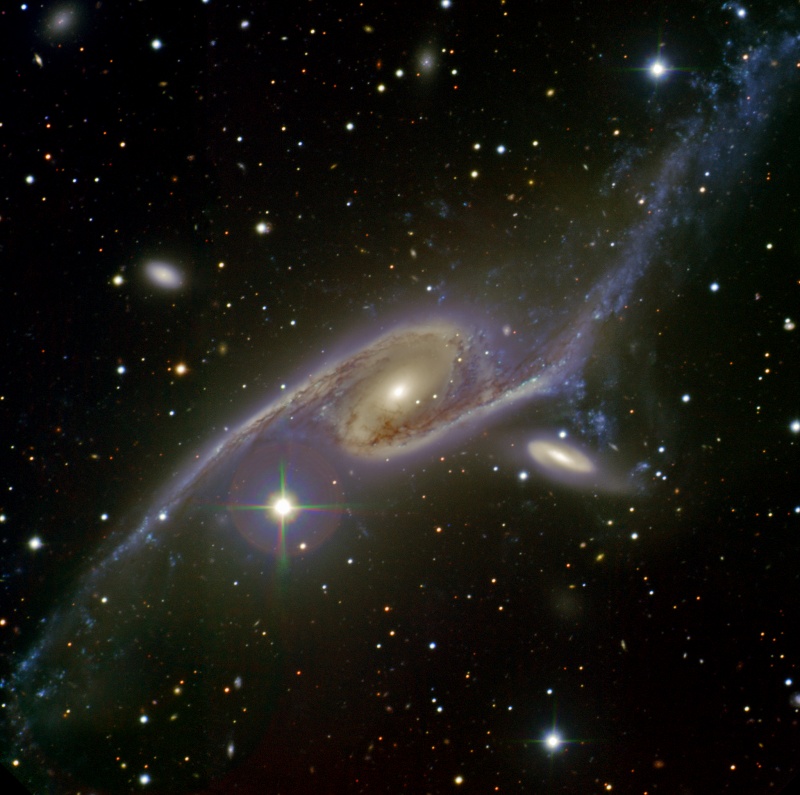
This is a picture of two galaxies merging.  We can tell by the asymmetric form, and the stream near the small galaxy.

However, what is really interesting is that there are 2 strong x-ray sources in the smaller Milky Way sized galaxy.  These could be twin black holes. The only time we've seen binary black holes has been when two galaxies have been in the process of merging, so perhaps these two x-ray sources are black holes which  have been formed in the past by two other galaxies merging so perhaps when galaxies merge, either the black holes merge too, or form some sort of stable orbit. [Source: Starts with a Bang]

5th April 2011 Star Ripped Apart by Black Hole


Astronomers may have witnessed a star torn apart by a black-hole

It seems that astronomers have spotted what looks like a star being ripped apart by a black hole. As gravity weakens with distance, and stars are rather large, the pull of gravity on one side of the star is greater than the other. The hypothesis is that that side gets pulled in faster and faster so the star gets ripped apart. Wow.

Monday, 4 April 2011

3rd April 2011 Nucleosynthesis in the Big Bang

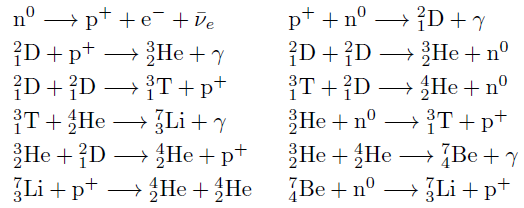
Today, I've been digging a little deeper into nucleosynthesis, and looking at exactly how each element was thought to have formed in the Big Bang.  Using this information


 from Wikipedia's page on nucleosynthesis, I drew the following diagram.  Where a neutron or proton is produced, it is written by the side of the fusion lines.  The short star pattern of lines is gamma radiation. Where a proton or neutron is used in the reaction, it is joined by a line.


As to the question posed in the diagram, this post discusses it but doesn't seem to come to any conclusion.

Saturday, 2 April 2011

2nd April 2011 Formation of Elements

Hydrogen, Helium, Lithium, Beryllium

The vast majority of hydrogen and helium are believed to have been formed in the Big Bang.

Protium, that is, 1H is also formed  produced by spallation. Both helium-4 and protium  are formed by radioactive decay; protium by proton and neutron emission and helium as alpha particles. Helium is also formed in stars by the fusion of hydrogen.

Stars are clouds of hydrogen and helium which have collapsed under their own gravity.  At the core of the star, the atoms are under high temperature and pressure, and in these conditions can fuse together.

When our sun has run out, in 4-5 billion years, of hydrogen  to fuse into helium, it will collapse forming a white dwarf star, and then die.

The nuclei of these elements, along with some 7Li, and 7Be are believed to have been formed when the universe was between 100 and 300 seconds old. Because all this happened in a very short period of time, only the lightest of elements could form, that is, hydrogen, helium, lithium, beryllium and maybe boron.

The Elements up to & including Iron

The formation of elements other than isotopes of hydrogen and helium , and a small scattering of lithium, occurs in very massive stars.  When these stars run out of hydrogen at their core, they contract down which means their temperature increases and the helium can start to fuse together, gradually forming heavier and heavier atoms with successive collapses. This forms rings of different elements being compressed in to the core.

Image from Wikipaedia

The elements produced are those up to and including iron in the periodic table, that is, helium, lithium, beryllium, boron, carbon, nitrogen, oxygen, fluorine, neon, sodium, magnesium, aluminium, silicon, phosphorus, sulphur, chlorine, argon, potassium, calcium, tin, titanium, vanadium, chromium, manganese, iron.

Why does it stop at iron?

It's to do with something called binding energy.  This binding energy is calculated, using conservation of matter, from the mass deficit which is the amount of mass reduction when the atom forms compared with its component parts, namely (mass of individual protons and neutrons)- (mass of  atom).  The graph shows the average binding energy per nucleon (neutron or proton in the nucleus).

The Average Binding Energy per Nucleon

Because iron is at the peak of the graph, fusing iron atoms together doesn't release any additional energy, and furthermore it requires energy to occur. (Why can't two atoms of the left combine to jump past iron? Must be something like this: the gradients are such that (the binding energy per nucleon on left at x=a) > (binding energy per nucleon at x =2a) )

The Elements after Iron

Iron is the end of the process for energy producing fusion, since fusing iron atoms does not produce any energy for the star. Since the core is no longer producing outward thermal pressure, but gravity is still compressing things in, if the star has a mass of less than 5 times the mass of our sun, it collapses into a dense ball of neutrons.  This is called a neutron star and can be as little as 10km across. When the implosion is stopped by the neutrons, matter bounces off the iron core turning the implosion into an explosion and thus creating a type II supernova.  This explosion blasts the outer regions of the star into space.  It is thought that the heavier elements are formed in this explosion.

Note that if the mass of the core is greater than 5 times the mass of our sun, the neutrons can not stop the implosion and a black hole is formed.

Sources

  1. Diamonds in the Sky - Universal Alchemy - a brief overview of the topic
  2. Eureka: The Death of Stars - Balancing energy from fusion against gravity
  3. Sxity Symbols: Element Creation - video explaning the formation of elements in the life of a star
  4. Nuclear Binding Energy - explains the energy from fusion and why iron is significant
  5. Supernovae - Types of supernovae, and what happens when they die
  6. Type II supernova - the life of a star
  7. Gravitational Energy
  8. Nucleosynthesis 

Friday, 1 April 2011

1st April 2011 Seeing Impacts in Planet Rings

Over the years, lines have been observed in the rings of Jupiter.  These lines can be traced back to when a comet is known to have hit Jupiter in 1993.

Sources

  1. SETI - How to Catch a Comet
  2.  Greg Laden - Ripples in Planetary Rings Are Traces of Decades-Old Cometary Collisions
  3.  NASA - Forensic Sleuthing Ties Ring Ripples to Impacts

Tuesday, 29 March 2011

26nd March 2011 - Alpha Beta Gamma Paper & Neutrinos


Alpha Beta Gamma  Paper (1948) -  In the first 3 minutes after the Big Bang,  protons and neutrons  bumped into each other they stuck together. There were about 7 protons to each neutron.  When 1 neutron and 1 proton stuck together they formed the nucleus of a Deuterium atom. It was too hot for the electrons to stick to make it an atom. If two of these Deuterium atoms stuck together, they formed an alpha particle, the nucleus of a Helium-4 atom.

By 17 minutes, all of the neutrons had bound themselves into Helium nucleii.

Not much happened until about 350k years when the electrons had cooled enough to join the nucleii to form Helium atoms.  Alpher came up with the idea that 75% of the universe is made of hydrogen, and 25% of Helium, by weight.   This is correct for interstellar space. It is supporting evidence for the Big Bang Theory.

The other, heavier elements are made in the centre of stars.


Neutrinos   - They have very little mass, if any, no electrical charge and they pass through pretty much everything.  It's been calculated that it would take 4 light years of lead to stop them! They are abundant. They are produced in the sun in fusion.  It starts with four Hydrogen nucleii which are basically protons. They want to form a Helium so two protons get converted to two neutrons.  When this happens, a positron and a neutrino are emitted. The neutrino shoots out of the sun and heads towards us.

Neutrinos are good candidates for dark matter.

There are  50 x 10^12 neutrinos passing through our bodies every second.

There are three types of neutrinos, electron, muon and tau These types are called flavours.  Neutrinos can change flavour which means they must have mass.

They were originally detected deep underground in carbon tetrachloride.  Sometimes they bump into a chlorine atom and transmute that chlorine atom into an argon atom.  You've then got to find that argon atom.  Talk about a needle in a haystack!

Nowadays, heavy water is used and the neutrinos are detected as light.  The reason it's deep underground is because cosmic rays will also produce the light reaction.