 |
| NASA |
Showing posts with label asteroid. Show all posts
Showing posts with label asteroid. Show all posts
Saturday, 16 April 2011
15th April 2011 In Search of Asteroid Moons
Ceres has no satellites larger than 1 or 2 km in diameter and Vesta has none over 50m. [Planetary Society]
243 Ida has a satellite Dactyl which was discovery by Galileo about 14 minutes before its closest approach on August 28, 1993.

Wednesday, 13 April 2011
13th April 2011 Asteroid Belt
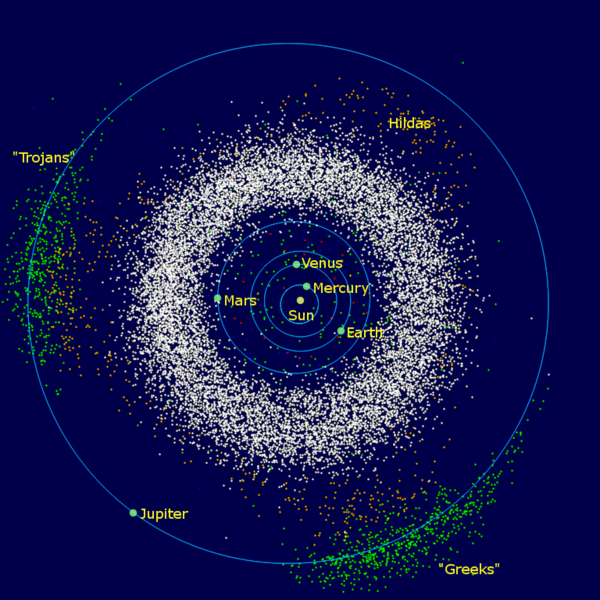 |
| The Main Asteroid Belt shown in White |

The main asteroid belt lies between Mars and Jupiter. It consists of asteroids from a few centimetres in diameter to the size of a dwarf planet.
Due to strong gravitational forces, it is impossible for a planet or large protoplanet to survive between Mars and Jupiter without being ripped apart. So the asteroid belt might be the remains of a planet which has been ripped apart.
Discovery of the First Asteroid
Many calculations were done in the early 18th century to calculate the number of asteroids and accurate answers were found. However, actually seeing the asteroids was a more difficult problem, and it took until 1st January, 1801 for Guiseppe Piazzi to find the first one. He wrote in his diary"The light was a little faint, and of the colour of Jupiter, but similar to many others which generally are reckoned of the eighth magnitude. Therefore I had no doubt of its being any other than a fixed star. In the evening of the second I repeated my observations, and having found that it did not correspond either in time or in distance from the zenith with the former observation, I began to entertain some doubts of its accuracy. I conceived afterwards a great suspicion that it might be a new star. The evening of the third, my suspicion was converted into certainty, being assured it was not a fixed star. Nevertheless before I made it known, I waited till the evening of the fourth, when I had the satisfaction to see it had moved at the same rate as on the preceding days."and in a letter to astronomer Barnaba Oriani of Milan he made his suspicions known in writing:
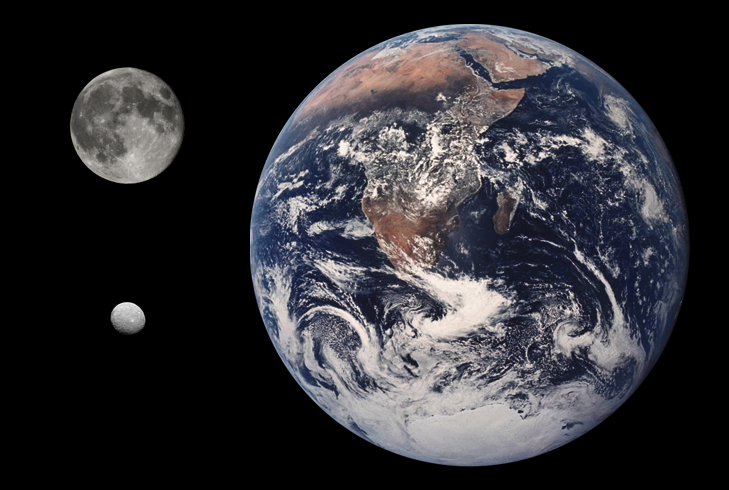
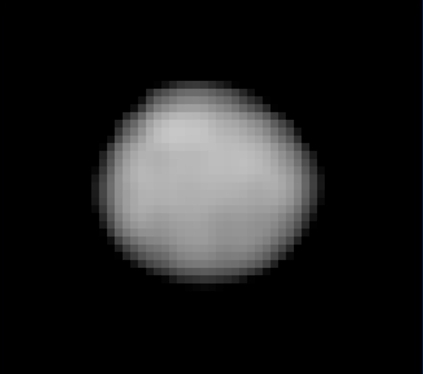
"I have announced this star as a comet, but since it is not accompanied by any nebulosity and, further, since its movement is so slow and rather uniform, it has occurred to me several times that it might be something better than a comet. But I have been careful not to advance this supposition to the public."Piazzi called his discovery Ceres, and for 50 years it was known as the 8th planet in the Solar System. It is the largest of the asteroids and is now classified as a dwarf planet. It is the only dwarf planet in the asteroid belt. Its diameter is about 950 km and contains 32% of the belt's total mass.
 | |||
| Ceres - taken by Hubble |
 |
| From Wikimedia Commons |
First Ten Asteroids Discovered
 |
| Sizes of the first ten Asteroids to be discovered compared to the Earth's Moon, all to scale. |
| Name | Size | Mass % of belt mass (x 1020 kg) | Discovery date |
Discoverer |
|---|---|---|---|---|
| 1 Ceres | 950 km diameter | 32% 9.43 ± 0.07 | 1st January, 1801 | Guiseppe Piazzi |
| 2 Pallas | 530-565km diameter | 7% 2.11 ± 0.26 | 28th March, 1802 | Heinrich Olbers |
| 3 Juno | 320×267×200 km | 1% 0.267 | 1st September, 1804 | Karl Ludwig Harding |
| 4 Vesta | 578×560×458 km | 9% 2.67 ± 0.02 | 29th March, 1807 | Heinrich Olbers |
| 5 Astraea | 167×123×82 km | 0.1% 0.029 | 8th December, 1845 | Karl Ludwig Hencke |
| 6 Hebe | 205×185×170 km | 0.4% 0.128 | 1st July, 1847 | Karl Ludwig Hencke |
| 7 Iris | 225×190×190 km | 0.4% 0.136 | 13th August, 1847 | John Russell Hind |
| 8 Flora | 136×136×113 km | 0.1% 0.043 | 18th October, 1847 | John Russell Hind |
| 9 Metis | 235×195×140 km | 0.5% 0.147 ± 0.020 | 25th April, 1848 | Andrew Graham |
| 10 Hygiea | 500×385×350 km | 3% 0.885 | 12th April, 1849 | Annibale de Gasparis |
Monday, 11 April 2011
11th April 2011 Asteroid - Kleopatra
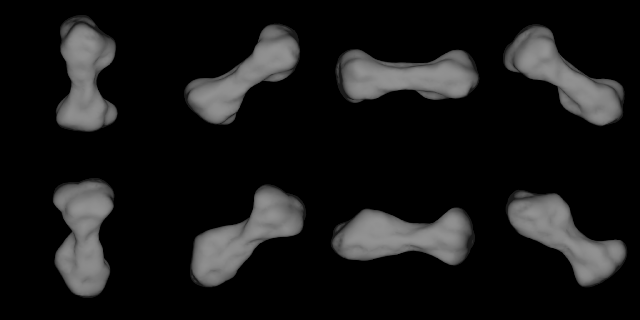
Kleopatra is a 217 km long and 58 km wide asteroid which was discovered on April 10, 1880 by Johann Palisa.. In 2000, it was found to be shaped like a bone. It orbits the sun in an orbit outside Mars. It rotates by tumbling end over end.
A recent study determined that Kleopatra is 30-50% empty space.
It also has two moons, Cleoselene (inner) and Alexhelios (outer), which were discovered in 2008. They are between 5 and 10 km in diameter and orbit at 454 and 678 kilometers around Kleopatra.
The Planetary Society
Astroblogger
Wikipedia
NASA
 |
| NASA |
It also has two moons, Cleoselene (inner) and Alexhelios (outer), which were discovered in 2008. They are between 5 and 10 km in diameter and orbit at 454 and 678 kilometers around Kleopatra.
Sources
Bad AstronomyThe Planetary Society
Astroblogger
Wikipedia
NASA
Wednesday, 6 April 2011
6th April 2011 Horseshoe Orbit
I found this diagram most misleading as it looks like it is from the viewpoint of someone outside the bodies involved yet it is actually showing the relative position of the asteroid with respect to Earth and the Sun.

The asteroid is in almost the same orbit as earth. When it is in a slightly smaller orbit, it moves faster, catching up the earth. When it approaches the earth at A, it is pulled into a larger orbit (A->B->C) and thus orbits the sun more slowly, so that it falls behind earth. Eventually, Earth catches up at D, pulling it into a smaller orbit (D->E) so that it speeds up and travels away from Earth. At no point does it ever pass Earth in its orbit.

Universe Today Article
NASA: Animations of a Horseshow Orbit
Wiki: Horseshoe orbit

The asteroid is in almost the same orbit as earth. When it is in a slightly smaller orbit, it moves faster, catching up the earth. When it approaches the earth at A, it is pulled into a larger orbit (A->B->C) and thus orbits the sun more slowly, so that it falls behind earth. Eventually, Earth catches up at D, pulling it into a smaller orbit (D->E) so that it speeds up and travels away from Earth. At no point does it ever pass Earth in its orbit.

Universe Today Article
NASA: Animations of a Horseshow Orbit
Wiki: Horseshoe orbit
Subscribe to:
Posts (Atom)