Showing posts with label flora. Show all posts

Monday, 25 April 2011

24th April 2011 Fractals

This video is a short introduction to fractals. It explains their repetitive nature, called self symmetry, and briefly introduces fractional dimension, that is that some things have dimensions other than 1,2 or 3.


Koch Snowflake

This fractal is called the Koch Snowflake. Starting with an equilateral triangle, the snowflake is formed by splitting each edge into thirds and then, for each edge drawing another triangle with the centre third of the line as its base. This is repeated infinitely.
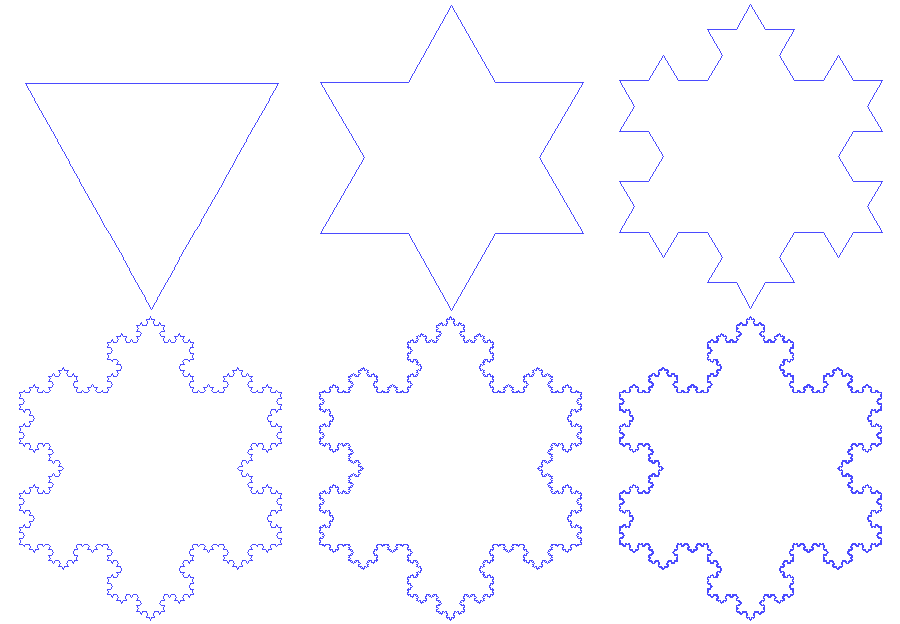
By António Miguel de Campos via Wikipedia
At any step, the length of the line is 4/3 times longer than on the previous iteration, since three sections are replaced by four. This means that the line formed enclosing the snowflake has infinite length. This infinite length surrounds a finite area.

Calculation of Area of Koch Snowflake

At iteration 1, there are 3 edges of length s.
At iteration 2, there are 4 * 3 edges since each edge is replaced by 4 edges of length 1/3 s.
At iteration 3, there are 4*(4*3) = 42 * 3 edges since each of the 4 * 3 edges is replaces by 4 edges of length 1/3 * (1/3 s) = 1/32  s.
...
At iteration n, there are 4n-1 * 3 edges of length 1/3n-1 s.

If the area of the original triangle is A, then the area of one of the additional triangles is (1/3)2 times the area of the original triangle because the length of its base is a third of the size of original.  There are 3 such triangles so the total area after one iteration is

A +3(1/3)2A = A(1 + 1/3) = 4/3 A.

At iteration n, there will be one new triangle for each edge in the previous iteration, iteration n-1 giving 4n-2*3 triangles. The area of these triangles will each be (1/3n-1)2A = (1/32)n-1A  = (1/9)n-1A = 1/9n-1A where A is the area of the original triangle. This gives an increase in area from iteration n-1 to iteration n of

4n-2*3 * 1/9n-1A = 3 * 4n-2/9n-1A

So, after n iterations, the total area is

4/3 A + 3*4/92A + 3*42/93 +...+ 3*4n-2/9n-1.

Apart from the first term, 4/3 A, this is a geometric progression, with initial term   a=3*4/92A and common ratio r=4/9. As n tends to infinite, we have the sum of an infinite geometric progression with 0<r<1. The sum of this is

a/(1-r) =   3*4/92A / (1 - 4/9) = 3*4/92A*9/5 =  4/15 A,

and hence the total area of the Koch snowflake is

   4/3 A + 4/15 A = 24/15 A = 8/5 A.

Hence, the area is 1.4 times the area of the original triangle.

Fractal Dimension

The fractal dimension of the Koch Snowflake can be thought of as too big to be 1 dimensional because every piece of it is made up of lots of smaller pieces joined at angles which means it is not like a line. It's also too small to be two-dimensional as it doesn't cover a plane.

To convert an increase in the length by a fixed factor of the sides of an object in Euclean space (everyday space) to the corresponding increase in area, we have to square the factor. For instance, if we triple the length of the sides of a rectangle we have to multiply the area of the rectangle by 32. If we increase the length of the sides of a three dimensional object, he have to cube the factor we increased the length by. In other words, we can consider dimension as the power we have to use to convert.

Another way of looking at it is to look at a decrease in length.  Suppose we decrease a length by a factor of  1/f. How many copies of the new object will it take to cover the new object?  For example, if we cut the sides of a cube in half, then we can fit 23=8 smaller cubes inside the original cube.

Suppose we decrease the length of the side by a factor 1/f.  How many copies F of the new object will we need to fill the old object?

in 2-dimensions is F=f2,
in 3-dimensions is F=f3, and
in D-dimensions is F=fD.

To extract D from this, we use logs.

log F= log (fD)
log F = D log f
D = log F/log f

For the Koch Snowflake, at each iteration, 1 line is replaced by 4 lines, each of length 1/3 the original. Hence F=4 and f=3, and so its fractal dimension is log 4/log 3  which is about 1.26.

Sources

Wikipedia: Koch Snowflake
Wikipedia: Fractal dimension

Wednesday, 13 April 2011

13th April 2011 Asteroid Belt

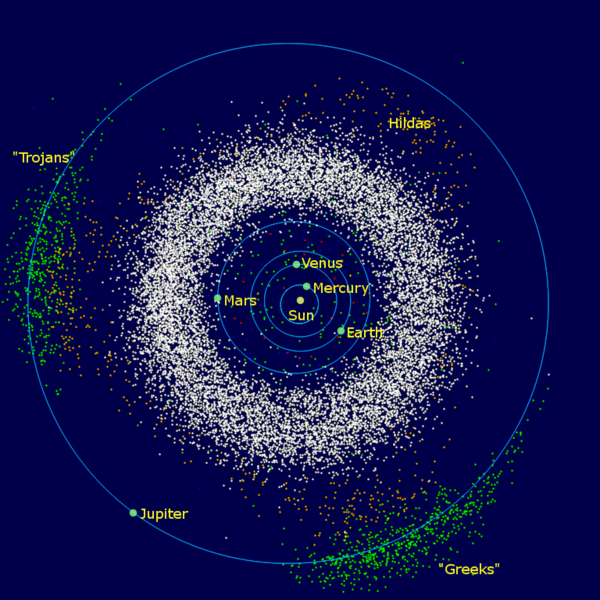
The Main Asteroid Belt shown in White

The main asteroid belt lies between Mars and Jupiter. It consists of asteroids from a few centimetres in diameter to the size of a dwarf planet.

Due to strong gravitational forces, it is impossible for a planet or large protoplanet to survive between Mars and Jupiter without being ripped apart. So the asteroid belt might be the remains of a planet which has been ripped apart.

Discovery of the First Asteroid

Many calculations were done in the early 18th century to calculate the number of asteroids and accurate answers were found. However, actually seeing the asteroids was a more difficult problem, and it took until 1st January, 1801 for Guiseppe Piazzi to find the first one. He wrote in his diary
"The light was a little faint, and of the colour of Jupiter, but similar to many others which generally are reckoned of the eighth magnitude. Therefore I had no doubt of its being any other than a fixed star. In the evening of the second I repeated my observations, and having found that it did not correspond either in time or in distance from the zenith with the former observation, I began to entertain some doubts of its accuracy. I conceived afterwards a great suspicion that it might be a new star. The evening of the third, my suspicion was converted into certainty, being assured it was not a fixed star. Nevertheless before I made it known, I waited till the evening of the fourth, when I had the satisfaction to see it had moved at the same rate as on the preceding days."
and in a letter to astronomer Barnaba Oriani of Milan he made his suspicions known in writing:
"I have announced this star as a comet, but since it is not accompanied by any nebulosity and, further, since its movement is so slow and rather uniform, it has occurred to me several times that it might be something better than a comet. But I have been careful not to advance this supposition to the public."
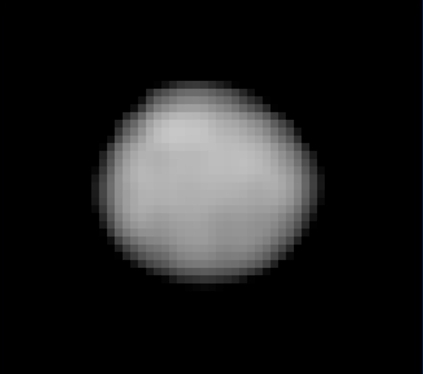
Piazzi called his discovery Ceres, and for 50 years it was known as the 8th planet in the Solar System.  It is the largest of the asteroids and is now classified as a dwarf planet. It is the only dwarf planet in the asteroid belt. Its diameter is about 950 km and contains 32% of the belt's total mass.
Ceres - taken by Hubble
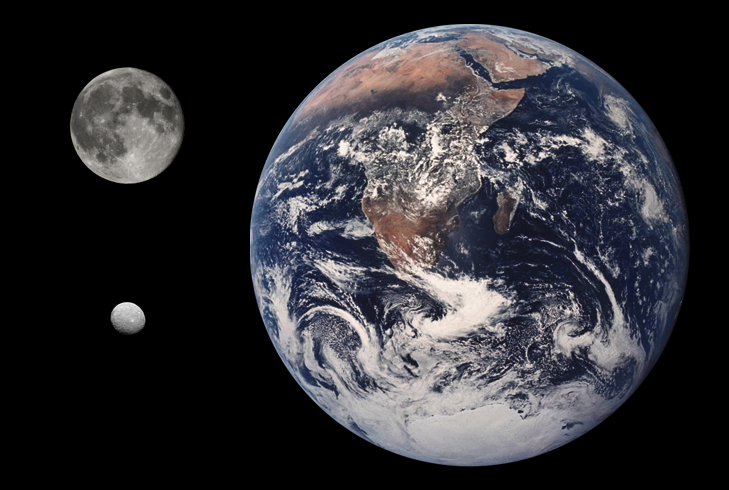
The following image from NASA shows the comparison of sizes between Earth, the moon and Ceres.
From Wikimedia Commons

First Ten Asteroids Discovered

Sizes of the first ten Asteroids to be discovered compared to the Earth's Moon, all to scale. 
NameSizeMass
% of belt mass
  (x 1020  kg)  
Discovery
date
Discoverer
1 Ceres  950 km diameter      32%
9.43 ± 0.07
1st January, 1801  Guiseppe Piazzi
2 Pallas530-565km diameter      7%
2.11 ± 0.26
28th March, 1802 Heinrich Olbers
3 Juno320×267×200 km     1%
0.267 
1st September, 1804Karl Ludwig Harding
4 Vesta578×560×458 km     9%
2.67 ± 0.02
29th March, 1807Heinrich Olbers
5 Astraea167×123×82 km     0.1%
0.029
8th December, 1845Karl Ludwig Hencke
6 Hebe 205×185×170 km     0.4%
0.128
1st July, 1847Karl Ludwig Hencke
7 Iris
225×190×190 km
      0.4%
0.136
13th August, 1847John Russell Hind
8 Flora136×136×113 km      0.1%
0.043
18th October, 1847John Russell Hind
9 Metis
235×195×140 km
       0.5%
0.147 ± 0.020
25th April, 1848Andrew Graham
10 Hygiea500×385×350 km      3%
0.885
12th April, 1849
Annibale de Gasparis
365 Days of Astronomy