In a conversation with a friend, the loss of light between two mirrors came up. That got me thinking as to why the light was lost. Was it some sort of cool quantum effect? Maybe I've been reading too much quantum stuff that I want something weird and wonderful to be happening. I went on a search for information to see if any of my ideas were in the right direction and this is what I've found so far.
In a metal, and thus mirrors with a metallic backing, light is absorbed by electrons and then re-emitted. I don't know why it's emitted at the angle it is but I think it's to do with waves but that is a question for another day. The following are reasons why the intensity of the beam diminishes.
Some light is scattered by imperfections in the mirror, so called diffuse reflection
Some light is scattered by the air
Even if the mirror were perfect, some energy would be lost due to conduction between electrons
I can see I have a lot more to read up about on this topic so I'll look at it a bit more over the next few days and see if I can make any sense of it.
This video is a short introduction to fractals. It explains their repetitive nature, called self symmetry, and briefly introduces fractional dimension, that is that some things have dimensions other than 1,2 or 3.
Koch Snowflake
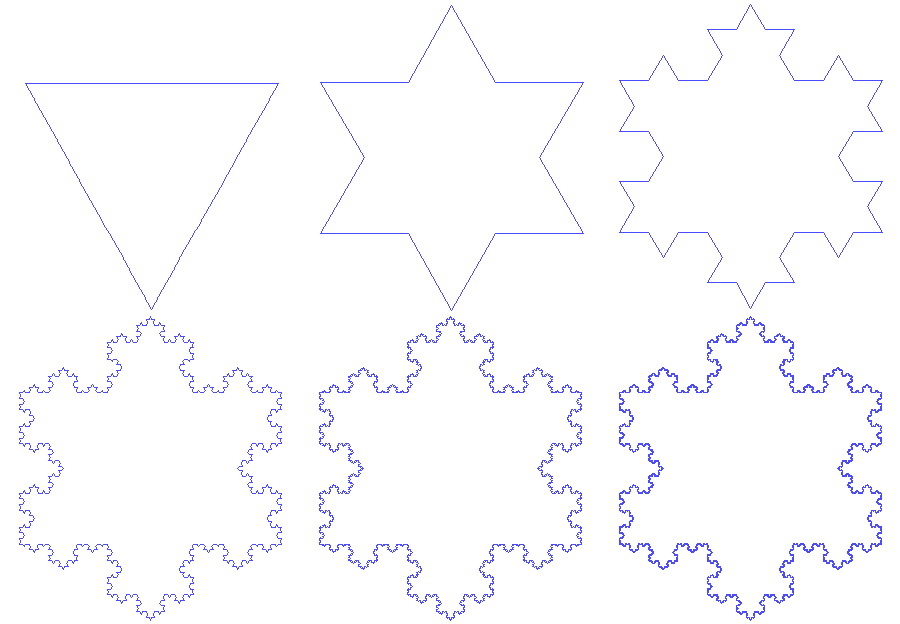
This fractal is called the Koch Snowflake. Starting with an equilateral triangle, the snowflake is formed by splitting each edge into thirds and then, for each edge drawing another triangle with the centre third of the line as its base. This is repeated infinitely.
At any step, the length of the line is 4/3 times longer than on the previous iteration, since three sections are replaced by four. This means that the line formed enclosing the snowflake has infinite length. This infinite length surrounds a finite area.
Calculation of Area of Koch Snowflake
At iteration 1, there are 3 edges of length s.
At iteration 2, there are 4 * 3 edges since each edge is replaced by 4 edges of length 1/3 s.
At iteration 3, there are 4*(4*3) = 42 * 3 edges since each of the 4 * 3 edges is replaces by 4 edges of length 1/3 * (1/3 s) = 1/32 s.
...
At iteration n, there are 4n-1 * 3 edges of length 1/3n-1 s.
If the area of the original triangle is A, then the area of one of the additional triangles is (1/3)2 times the area of the original triangle because the length of its base is a third of the size of original. There are 3 such triangles so the total area after one iteration is
A +3(1/3)2A = A(1 + 1/3) = 4/3 A.
At iteration n, there will be one new triangle for each edge in the previous iteration, iteration n-1 giving 4n-2*3 triangles. The area of these triangles will each be (1/3n-1)2A =
(1/32)n-1A
= (1/9)n-1A
= 1/9n-1A where A is the area of the original triangle. This gives an increase in area from iteration n-1 to iteration n of
4n-2*3 * 1/9n-1A = 3 * 4n-2/9n-1A
So, after n iterations, the total area is
4/3 A + 3*4/92A + 3*42/93 +...+ 3*4n-2/9n-1.
Apart from the first term, 4/3 A, this is a geometric progression, with initial term
a=3*4/92A
and common ratio r=4/9. As n tends to infinite, we have the sum of an infinite geometric progression with 0<r<1. The sum of this is
Hence, the area is 1.4 times the area of the original triangle.
Fractal Dimension
The fractal dimension of the Koch Snowflake can be thought of as too big to be 1 dimensional because every piece of it is made up of lots of smaller pieces joined at angles which means it is not like a line. It's also too small to be two-dimensional as it doesn't cover a plane.
To convert an increase in the length by a fixed factor of the sides of an object in Euclean space (everyday space) to the corresponding increase in area, we have to square the factor. For instance, if we triple the length of the sides of a rectangle we have to multiply the area of the rectangle by 32. If we increase the length of the sides of a three dimensional object, he have to cube the factor we increased the length by. In other words, we can consider dimension as the power we have to use to convert.
Another way of looking at it is to look at a decrease in length. Suppose we decrease a length by a factor of 1/f. How many copies of the new object will it take to cover the new object? For example, if we cut the sides of a cube in half, then we can fit 23=8 smaller cubes inside the original cube.
Suppose we decrease the length of the side by a factor 1/f. How many copies F of the new object will we need to fill the old object?
in 2-dimensions is F=f2,
in 3-dimensions is F=f3, and
in D-dimensions is F=fD.
To extract D from this, we use logs.
log F= log (fD)
log F = D log f
D = log F/log f
For the Koch Snowflake, at each iteration, 1 line is replaced by 4 lines, each of length 1/3 the original. Hence F=4 and f=3, and so its fractal dimension is log 4/log 3 which is about 1.26.
When a photon hits brick, it takes an electron from a low energy state to a higher energy state. It's like picking a ball up from the floor to the table. The ball can only be on the floor or the table. When the photon takes the electron from the 'floor' to the 'table', it is absorbed and so can not pass through.
When a photon hits glass, the excited state is way too high for the visible light photon to lift it up to that state. This means the light isn't absorbed and passes through. The gap between the 'normal' state and the excited state is called the energy gap.